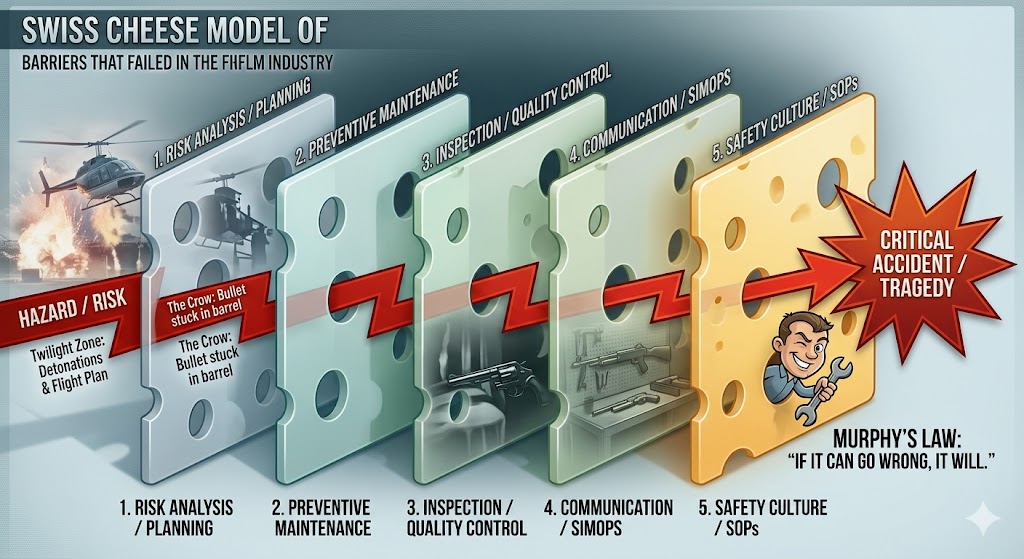

“In the cinematic world, we often talk about ‘movie magic,’ but for those of us in the risk management field, magic is simply the result of invisible, rigorous safety protocols. From high-stakes stunts to the complex logistics of a crowded set, the line between a successful take and a critical failure is often found in the holes of the ‘Swiss Cheese Model.’ This technical analysis explores how we apply professional safety standards to the art of storytelling.”
During my years in the Occupational Safety and Health (OSH) field, I always started my training sessions for new groups with a rhetorical question: “Which is the only job we can be absolutely certain will be accident-free?”
After listening to countless complex theories and procedures, I would give them the simplest answer in the world: “The safest job is the one that doesn’t get done.”
This reflection is the essential starting point for understanding risk management. Since “not doing the job” is not a viable option in a productive economy, we are left with only one real alternative: Proactive Prevention.
This premise is universal. It applies as much to a chemical plant as it does to a Hollywood film set. Witnessing tragedies in the film industry leads me to reflect on how, even in highly choreographed and controlled environments, safety barriers can fail catastrophically.
The Inevitability of “Murphy’s Law” and Risk Management
Often, accident investigations focus on finding a “scapegoat” or blaming individual negligence. However, as safety professionals, we know that Murphy’s Law—”If anything can go wrong, it will”—is a constant factor lurking around every corner.
The true technical challenge of prevention is not simply hoping people follow the rules, but designing redundant systems that assume Murphy’s Law will try to sneak in at the least expected moment. Complacency and a lack of “chronic unease” regarding potential failures are the greatest enemies of a solid safety culture.
A Technical Analysis of Failed Barriers in Cinema
Analyzing these cases from the outside presents obvious challenges. As investigators, we know that reaching the root cause requires reviewing work permits, Preventive Maintenance (PM) logs, and conducting structured interviews to detect inconsistencies. However, based on official reports, we can identify critical failures in defensive barriers.
Let’s look at three cases to illustrate key industrial safety concepts:
- Communication and Coordination Failure (Twilight Zone, 1982):
- The Accident: A helicopter crash involving actor Vic Morrow and two child actors due to pyrotechnic detonations.
- Technical Analysis: This case demonstrates a massive failure in interface management and communication. In industrial safety, if the “right hand” (pyrotechnics) doesn’t know what the “left hand” (the helicopter pilot) is doing, disaster is imminent. The lack of a comprehensive risk analysis for simultaneous operations (SIMOPS) and ineffective supervision were key factors.
- Quality Control and Equipment Maintenance Failure (The Crow, 1993):
- The Accident: The death of Brandon Lee from a prop gun shot that contained a real projectile.
- Technical Analysis: This accident is a clear example of a failure in Quality Assurance/Quality Control (QA/QC) and the inspection of critical equipment. A real bullet tip was stuck in the barrel from a previous scene. The “final inspection” barrier before entering the set failed catastrophically. In any industry, if critical equipment is not checked before every high-risk operation, the result can be fatal.
- Safety Culture and Standard Procedure Failure (Rust, 2021):
- The Accident: The fatal shooting of cinematographer Halyna Hutchins with a prop gun loaded with a live round.
- Technical Analysis: This case highlights the concept of Safety Culture over mere procedure. Fundamental protocols were violated: the armorer was not present, the assistant director handed over the weapon, and crucially, a live round made it onto the set. When production haste prevails over Standard Operating Procedures (SOPs), complacency becomes the most critical hazard. Safety cannot be an “optional” based on budget or time.
Conclusion and Professional Reflection
Whether we are operating a radio station, managing a refinery, or filming an action scene, prevention is not a bureaucratic burden; it is the fundamental engine that allows everyone involved to return home safe and sound at the end of the day.
As risk management professionals, our job is not simply to comply with the standard, but to actively anticipate chaos, fight complacency, and build resilient systems that can withstand even the tricks of our old friend “Murphy.” Luck is not a viable safety plan.
Tele and 73
“Versión en español próximamente en mi blog: Hablemos, Tele.”


Leave a comment